
AMION to update Employment Density Guidance

We are pleased to report that AMION has been appointed by Homes England to lead a multidisciplinary team updating the Strategic Impacts Model, including national employment density guidance. These benchmarks play an important role in planning, regeneration and investment decisions across the country, helping shape how employment land and premises are assessed, planned and delivered. Ensuring the guidance reflects today’s economy, workplaces and ways of working is therefore an important task. Over the coming months, we’ll be engaging with stakeholders from across the public and private sectors. The guidance is widely used, and we want the refreshed evidence base to benefit from the broadest possible range of experience and perspectives. For AMION Director Simon Dancer, this is something of a Groundhog Day moment. Simon helped initiate the original employment densities guidance in 2001, so having the opportunity to revisit and refresh it almost 25 years later is both rewarding and slightly surreal. It may also go some way towards explaining the grey hair. If you’d like to learn more, or think your organisation should be part of the conversation, please contact Simon at simondancer@amion.co.uk
60 seconds with…Chloe Wilson

We spoke to Chloe from our Economics team about her journey into the profession, the nature of her role at AMION, and the skills, experiences and interests that underpin her work in economic consultancy. Why economics? Like many at AMION, I studied economics at university as it offered a balance between maths and humanities — the subjects I most enjoyed at A Level. What appealed to me most was that it’s not just theory for its own sake, but a way of understanding how the real world works. That’s something I really value in my role now. Working in economic development means constantly linking theory and evidence to what’s actually happening in places across the UK. While I wasn’t familiar with the Green Book before joining AMION, many of its concepts — such as wellbeing and market failure — built directly on what I’d studied, so it felt like a natural progression. What does the role involve? The work is varied day to day. I might be designing survey questionnaires for major events, analysing data from a heritage site, or carrying out consultation interviews as part of an evaluation to understand people’s experiences. Alongside this, most days involve some form of economic impact analysis or social cost-benefit modelling, contributing to a wider evidence base for projects. What skills are most important? Strong organisation is key when managing time across multiple projects. A willingness to learn and adapt is also important, given the variety of work. Communication skills are equally important — particularly the ability to present complex analysis clearly and in a way that is accessible to different audiences. Outside of work Now it’s spring, I’m trying to get back into running — with evening runs and a weekly Parkrun. I also enjoy meals out and cocktails, and I’m a big reader. I recently joined a monthly book club, and my favourite so far has been The Women by Kristin Hannah – although we’ve stuck to fiction so far, so no Green Book appearances just yet. Chloe is a Senior Consultant within AMION’s Research and Evaluation Team
Integrated place-based business cases: aligning transport and economic development appraisal

Recent updates to the HM Treasury Green Book reinforce a direction of travel that has been evident for some time: investment decisions are increasingly expected to demonstrate how they contribute to outcomes for places, rather than relying solely on the isolated performance of individual schemes. This has implications not only for transport appraisal, but equally for the economic development and regeneration frameworks traditionally associated with MHCLG-style business cases. Many of the benefits associated with public investment in brownfield development and associated interventions, arise through the positive externalities of more sustainable development patterns. These include improved access to jobs and services, support for higher-density and mixed-use development, reduced reliance on private vehicles, and longer-term productivity and inclusion effects. Such impacts sit at the intersection of transport economics and economic development appraisal and are not well captured when either discipline is applied in isolation. The 2026 Green Book does not replace established appraisal frameworks, nor does it reduce the importance of quantitative analysis. Instead, it places greater emphasis on the Strategic Case, proportionality and a clear articulation of how investment leads to change. This creates a stronger basis for integrated, place-based business cases that consider transport, land use and development outcomes together, without relying on the extension of scheme-level benefit–cost ratios beyond their appropriate limits. Isn’t this covered by DfT TAG Wider Economic Impacts? It is important to distinguish this approach from the long-standing treatment of land-use change within transport appraisal, including dependent development and other “level 3” wider economic impacts under TAG. When I worked for National Highways as the economic advisor for all major road projects in the midlands and the north, we would often include level 3 wider economic impacts such as dependent development for bypass schemes that had come through the Housing Infrastructure Fund or running a land use and transport interaction model to capture productivity impacts where a road scheme causes firms to relocate, where they were relevant to do so. However, these were significant transport-led infrastructure projects that were addressing a problem in the transport market, but their scale, significance and/or location meant their impacts would spill out into land, labour and product markets as a second order effect. Integrated place-based business cases are not a way of incorporating additional impacts into a transport BCR. Rather, they reframe the investment logic by starting with a defined place, such as a station area, town centre or corridor, and assessing how transport networks, land use, market response and public-sector intervention combine to deliver economic and social value. What we have been doing at AMION This approach has informed our work on several of our projects over the last four years. These include projects and programmes such as the Ebbsfleet Central developments at the heart of Ebbsfleet garden city, the Hind Street regeneration in Birkenhead town centre, the Dudley to Brierley Hill light rail corridor and development areas surround several rail stations in the East Midlands. For each of these, economic appraisal has focused on how transport supports sustainable development and regeneration outcomes. In these cases, new transport infrastructure is not always the primary driver of value. Changes in land use, density and mix can themselves generate transport-related externalities, such as improved accessibility and mode shift, that are not captured within land value uplift or transport user benefits of associated infrastructure. We have agreed methodologies for capturing these externalities in a way that is consistent with TAG and MHCLG appraisal principles, although not explicitly in guidance, with multiple central government departments and regional combined authorities. These have made positive contributions to the value for money assessment of several projects. A consistent feature of this work is a disciplined treatment of additionality, uncertainty and delivery. Integrated place-based business cases are explicit about the conditions required for development outcomes to be realised, the role of public-sector coordination, and the limits of monetisation. Where impacts cannot be robustly quantified, they are evidenced through transparent assumptions, scenario testing and alignment with policy objectives, in line with Green Book principles. Could this be relevant to your project? As appraisal practice continues to evolve, integrated place-based business cases provide a practical way of bringing together transport economics and economic development appraisal within a single, coherent investment narrative, where it is appropriate to do so. If you think we can be of assistance in developing the business case for your integrated place based scheme, or would like to discuss more broadly, please feel free to get in touch with me at tommillard@amion.co.uk.
60 seconds with Ivy-Rimmer Tagoe!

Ivy is an economist within AMION’s transport team, with a particular interest in collective infrastructure. She has worked across sectors including transport, energy and green space. She has extensive experience in business case development, economic impact analysis and policy development, with a particular strength in assessing the wider environmental, health and social impacts of transport schemes across modes. What attracted you to transport economics and appraisal? I was attracted to transport economics and appraisal because transport sits at the point where economics, collective infrastructure and every day life meet. Economics can sometimes feel abstract but transport is something people experience every day. It shapes how we move through the world and has a direct impact on our wellbeing, opportunity and quality of life. When transport works well, it expands choice and independence. When it is absent, inaccessible or poorly designed, it can significantly limit people’s lives. I am an environmental economist and transport is also one of the most powerful levers we have for responding to the climate crisis. My interest in transport is closely tied to questions of justice and dignity. Growing up, I was aware of the “Piss on Pity” protests across the UK calling for the rejection of sympathy in favour of inclusion, agency and real decision-making power. Seeing people who have mobility- related disabilities excluded from public transport made it clear to me that transport decisions are far from neutral. When systems are inaccessible or poorly designed, they deny people independence and opportunity. Every person wants a transport system that includes them and works for their community. It is that understanding has stayed with me and continues to shape how I think about transport investment and appraisal today. At its core, my interest lies in the relationship between humans, agency and infrastructure. Transport systems determine who has real choices, who is constrained and who bears the costs – socially and environmentally. Few areas of economics are so immediately connected to both how people live now and how we safeguard the future. I see transport as social infrastructure, with a responsibility to support justice, inclusion and opportunity while operating within planetary boundaries. I believe we have a collective responsibility to one another to think carefully about the systems we design and the impacts they have. Transport economics gives me a way to engage seriously with that responsibility. It allows me to test assumptions, make all impacts visible, zoom out when needed and help shape decisions that support equity, opportunity and sustainability. What does your role at AMION involve day to day? My role at AMION focuses on transport modelling, appraisal and integrated assessment. On a day-to-day basis, I support clients to quantify the impacts of transport interventions and build clear, robust evidence to inform investment decisions and business cases. A significant part of my work involves setting out the case for change before any economic valuation begins. I focus on understanding the problem a transport intervention is trying to address and who it will impact. This requires a clear picture of local socioeconomic characteristics and existing transport infrastructure. I work with interventions from early concept and feasibility testing through development and stakeholder engagement stages to the development of the economic case and post-intervention evaluation. Throughout, I build an integrated evidence base that goes beyond connectivity alone. This includes impacts on place, accessibility, health, employment, education and the wider environment. The aim is to produce appraisals that are comprehensive and grounded in real-world experience, giving decision-makers a robust basis for delivering effective and inclusive transport schemes. What skills are most important for someone looking to work in transport economics? Transport economics requires strong technical capability and a clear understanding of how people, places, policy and systems interact. Transport appraisal, economic modelling and data analysis are essential to assessing impacts and supporting sound investment decisions. A strong grounding in DfT’s TAG frameworks ensures that analysis is transparent and trusted. Technical expertise must also be matched by the ability to communicate clearly and work across disciplines. As an economist, we often need to explain complex analysis, collaborate effectively with planners, local stakeholders and policymakers and provide well evidenced advice that supports decision-making. Personally, I think the ability to see the bigger picture is just as important as technical expertise. The appreciation of how transport investment can support regeneration and can strengthen economic resilience is increasingly important, particularly in the context of the climate emergency. What do you enjoy most about working on transport schemes? I enjoy seeing my analysis turn into something tangible. There is something incredibly motivating about knowing that your work can shape decisions that people will feel every day, whether through the creation of a more coherent public transport system or a safer cycle route. I like learning about different places and working on innovative transport and city-planning schemes, particularly at the research stage. Taking a deep dive into a place by examining different modes of transport, how regional networks function together, and how these interact with skills, employment and land use helps build a clear picture of how transport shapes access to jobs, services and opportunity. I also enjoy working with local authorities, other public sector bodies and communities who are developing more innovative and low-carbon transport offers. For example, my work with the Lake District National Park Authority to reduce emissions across all sectors and evaluate a range of low carbon transport options across the national park. What do you like to do outside work? I spend a lot of time exploring Edinburgh where I live. The city has an extraordinary concentration of great art and I am back at university in the evenings studying History of Art. I enjoy cinema, anthropology, literature and languages. Whenever I can, I love getting out of the capital to explore Scotland. I love learning about the history of the country and visiting the Highlands and its native plants and wildlife. For now, I am trying to survive another Scottish winter, which is considerably colder than last year’s!
Green Book 2026: Yes, minister… it’s all change

As a mandarin for many a year, and Green Book consultee, I can imagine the scene back in Whitehall. A minister bursts into the office, clutching the new Green Book, eyes shining. “Sir Humphrey, this is marvellous. It’s completely new.” Sir Humphrey adjusts his glasses, wryly smiles and replies “Indeed, Minister. Entirely new.” Only last week, after much trailing, the latest iteration of the Green Book finally landed. On first inspection it does look different. It is certainly shorter and there is less emphasis on unnecessary technical complexity. All very welcome. But what has really changed? The genius of His Majesty’s Treasury has never been brute force. It is process. Over decades, the Treasury has perfected the art of winning quietly, preferably while others believe they have secured a concession. The question, then, is whether the new Green Book is a masterclass in this venerable tradition? Take land value uplift, my favourite dinner table topic. It’s still there, doing the heavy lifting. Will a housing scheme in Wigan now perform better, on paper, than one in Westminster? Answers on a postcard to SW1. However, encouragingly, there is greater emphasis on external impacts such as the place-making effects for areas in need of regeneration. To misquote Morecambe & Wise, is it the same tune, played slightly faster, with a new arrangement? Ministers may believe they are backing regeneration and rebalancing. In practice are they still backing spreadsheets underpinned by high land values? Then there is our old friend, the benefit cost ratio, or BCR. This remains the supreme arbiter, the constitutional monarch of appraisal. Everything bows to it eventually. Time savings become money. Wellbeing becomes money. Environmental impacts become money. Of course, the new Green Book nods earnestly towards distributional effects and place-based outcomes, and this is to be praised, and used appropriately can make a difference. The Green Book remains the gold standard of appraisal guidance, respected across the globe. The real question is whether this new iteration changes outcomes. Will benefits be shared more fairly? Will environmental limits constrain economic arithmetic rather than being adjusted to fit it? To borrow Sir Humphrey’s phrasing again “That depends entirely on what you mean by change.” Simon Dancer leads our Economics service
New year, new… discount rate? Through the looking glass of the Green Book

Right, let’s talk about discount rates. Before you click away into something more exciting (cat memes, Wordle or bleeding the brakes on your car), hear me out. While most of us were swimming in a sea of eggnog and mince pies, His Majesty’s Treasury quietly kicked off a review of the Green Book discount rate. Exciting? Absolutely not. But if I could somehow squeeze out two blogs about land value uplift last year, this one should be a breeze. Jam today, rather than jam tomorrow When I was in Whitehall, the way I was taught to think about discounting came from Lewis Carroll and was later picked up by Keynes ‘jam today rather than jam tomorrow.’ In Treasury-speak, this captures the concept of ‘time preference’: the tendency for people to value benefits received today more highly than the same benefits received later. If you prefer jam today, you will value a benefit arriving next year less than the identical benefit arriving now. That preference is exactly what the discount rate captures. If you’re wondering whether I’m only telling this anecdote so I can sneak in sticky-end references and spread a few jam puns, shame on you, and guilty as charged. Discount rates, minus the equations Put bluntly, the discount rate converts future costs and benefits into today’s money. The higher the rate, the less weight we give to outcomes that happen far into the future. The Green Book’s standard approach uses something called a ‘social time preference rate’ (don’t go, you’ve made it halfway) which has attracted some criticism because it can make slow-burn transformational projects look underwhelming on paper. From my time as a mandarin in Whitehall, I can tell you this technical language masks political and practical consequences. Unlike Premier League football managers, the Green Book discount rate does not change every season. The last ‘boardroom vote of confidence’ was in 2003 when the headline rate was cut to 3.5 per cent. Why economic development professionals should care If your job is to make the case for patient investment in places, you will meet the discount rate early and often. Timing matters, as faster delivery brings benefits into the near term, which are worth more in present value terms (more HMT lingo), so speed can materially improve a project’s benefit-cost ratio without altering the fundamentals. For residential schemes, tenure and cashflow also matter. Adjusting housing tenure or revenue models alters grant requirements and cashflow, which changes present value calculations. Small delivery or tenure tweaks can move a business case from marginal to investable, or vice versa. There are also place-based benefits that spread through local markets, such as wider land value uplift that is sensitive to appraisal assumptions and discounting. How you value those spillovers can determine whether a project passes go or not. A modest tweak to the rate or to how it is applied can change which projects clear approval and which remain stuck. Indeed, the consultation scope asks whether the discount rate should be adjusted for place-based objectives and environmental scarcity. These are not academic issues. It is the difference between a project becoming reality, or the next Manchester United manager. Spreading the jam more evenly This review sits inside a wider effort to make the Green Book more supportive of place-based cases and less mechanically obsessed with single benefit-cost ratios, and more attentive to how the jam is actually spread over time. The discount rate is central because it literally changes how the future is counted. So yes, this is niche. It will not trend on LinkedIn (I’ve tried, twice). But like land value uplift, it is one of those quiet technicalities that decides what gets built, where and when. For economic development professionals arguing for patient, place-based investment, the Treasury’s conversation on discounting deserves a spot on your radar. Bring your spreadsheet, a mug of coffee, and remember that if the jam is always reserved for tomorrow, very little ever gets eaten. The consultation authors will provide an interim update to HM Treasury on its emerging findings in March 2026. They will then deliver their final findings by the start of June 2026 and publish their final findings by the end of June 2026. Simon Dancer is AMION’s Economics Director and a Board Member of the Institute of Economic Development (iED)
Homes England publishes AMION research on commercial-led regeneration
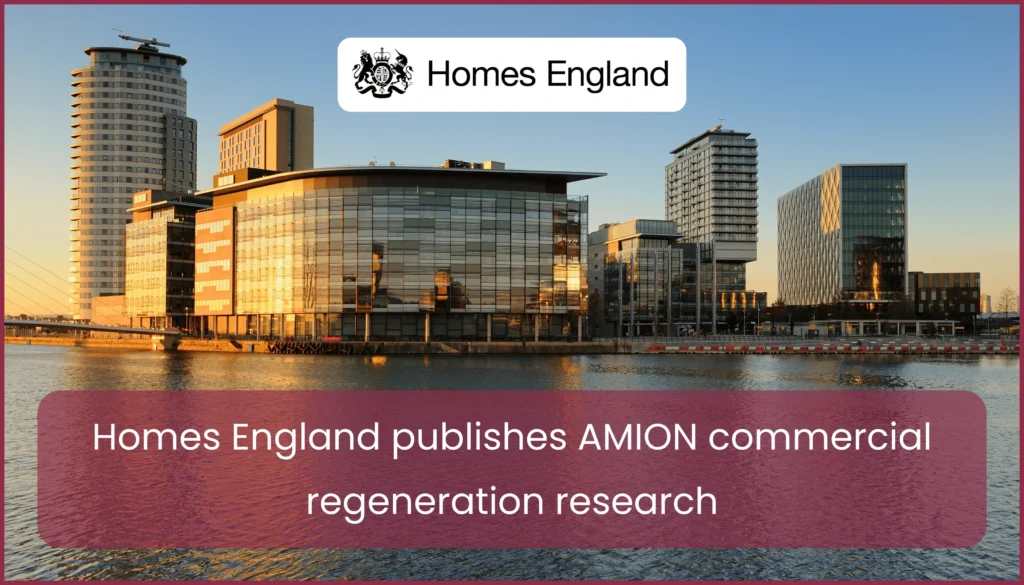
We’re pleased to share new national research for Homes England on the placemaking impacts of commercial-led regeneration. The study builds on earlier Homes England work on housing-led regeneration and feeds into the 2025 Ministry of Housing, Communities and Local Government (MHCLG) Appraisal Guide. It focuses on what commercial development means for local places, rental values and regeneration outcomes. What the research set out to do The study had two aims: first, to test whether public sector supported commercial-led development and public realm schemes with clear placemaking objectives influence nearby commercial rents over and above local trends; second, to draw out what this means for regeneration policy and economic appraisal. We used a hedonic pricing approach based on achieved rents from the CoStar database, comparing distance-based ‘rings’ around each scheme with an outer control area. This allowed us to capture positive spillovers and any local displacement where new supply might depress surrounding rents. A carefully selected set of case studies From a longlist of more than 100 schemes, we shortlisted 24 and, following data checks, modelled 11 in detail. These include major city centre projects and public realm interventions, such as MediaCity in Salford, Golden Square in Birmingham’s Jewellery Quarter, Bristol Temple Meads, Spinningfields in Manchester, and Liverpool One. In total, we ran 396 models across different ring sizes to test robustness. Headline findings Two schemes showed consistent positive spillovers with no offsetting negatives: MediaCity in Salford and Golden Square in Birmingham. MediaCity demonstrated rental uplifts of around 10% to 15% within 400 metres. Golden Square showed 8% to 16% rental gains, with signals that retail activity may be the main driver. Bristol Temple Meads displayed both patterns: positive spillovers of 12% to 26% up to 600 metres, alongside negative effects of 7% to 16% between 600 and 800 metres. This points to rebalancing within the commercial market as demand concentrates nearer the scheme. Two office-led schemes – Brindley Place in Birmingham and Spinningfields in Manchester – showed consistent negative spillovers, again over short distances. Six schemes, including Paradise (Birmingham), Snow Hill (Birmingham), Liverpool One, St Paul’s Square (Liverpool) and Newcastle Helix, showed no consistent overall spillovers, although some office or retail sub-sector models indicated partial effects. Why this matters for policy and appraisal Homes England’s mission is to support high-quality homes and thriving places, allocating public funds where they deliver the greatest social value. While commercial property is harder to analyse than housing due to data constraints, this research provides new evidence on additionality and local market effects: This matters for Green Book business cases and local growth strategies. Evidence of uplift can strengthen the case for targeted public realm and commercial investment. Evidence of localised negatives can inform mitigation, for example phasing, tenant mix, or complementary transport and public realm measures. Next steps Further work would help test cross-market effects, such as how commercial-led regeneration influences nearby house prices, and vice versa. More case studies over longer post-completion periods would also deepen the evidence base, particularly outside major urban centres. 🔗 Read the full report: Measuring Social Value Paper 8: Measuring the Placemaking Impacts of Commercial-led Regeneration – GOV.UK
One growth zone to rule them all? The logic behind Industrial Strategy Zones

If you thought the UK’s economic development toolbox already had too many acronyms, brace yourself – there’s a new one on the block: ISZs, or Industrial Strategy Zones. They’re not an entirely brand-new invention, but rather a tidy repackaging of Freeports and Investment Zones. The government’s goal? To unite their strengths, cut duplication, reduce overlap and make economic growth lingo less like a cryptic crossword. When Freeports met Investment Zones: the birth of ISZs The government’s new Industrial Strategy puts it plainly: businesses thrive in places that work. Its Plan for Change also stressed that devolution is central to this. Growth can’t be dictated from Whitehall; it must be led from the ground up. That’s why the government is working more closely with devolved administrations and metro mayors to shift decision-making closer to the people and the places it affects. Freeports and Investment Zones already play a part in that mission by helping to create jobs and drive growth in key sectors and city regions. But until now, they’ve often operated in silos, with separate funding streams, governance structures and even overlapping boundaries. That’s not exactly a recipe for joined-up delivery. Industrial Strategy Zones are the government’s answer: a single umbrella that brings Freeports and Investment Zones together. It’s a three-part plan: Liverpool City Region has already shown what this looks like in practice by bringing both together under a single framework as the Liverpool City Region Innovation Zone. In total, there will be 22 ISZs across the UK: ten with an Investment Zone, nine with a Freeport and three with both. Why the rebrand? Freeports, Investment Zones, Enterprise Zones (more on EZs shortly)… it’s fair to say the landscape had become a bit crowded. The rebrand to Industrial Strategy Zones isn’t just a fresh coat of paint, it’s about simplifying, sharpening and scaling what already works. Here are a few of the key drivers: Hang on a minute, what about Enterprise Zones? Not to be forgotten, England still has 45 EZs scattered across the country a bit like confetti from an earlier economic strategy. Some EZs overlap neatly with Freeports and Investment Zones, others less so, and their alignment with the new Industrial Strategy varies from place to place. Most of the original incentives that came with EZs have now expired, but they’re far from redundant. Many EZs still cover key industrial sites and generate valuable retained business rates that support local growth. The government plans to fold EZs into the new Industrial Strategy Zones, so that where an EZ sits inside an ISZ boundary, it can be brought under the same governance structure. A final thought Growth zones are only as powerful as the ambition behind them. Rebranding Freeports and Investment Zones as ISZs won’t, on its own, fix regional inequality or spark investment overnight. But it does give local leaders a more coherent, better aligned tool under their belt provided they’re ready to wield it. Article by Liam Cox, Senior Consultant at AMION.
Introducing our Place Economics Team

Our Team Across the UK, towns and cities are facing complex and interconnected challenges: how to attract investment, regenerate centres, unlock brownfield sites and ensure communities can thrive. Meeting these challenges requires a blend of skills and perspectives. AMION’s Place Economics team has been established to provide just that. By combining expertise in economics, property and planning, we are able to help clients build stronger cases for investment, shape regeneration strategies and demonstrate the long-term benefits of development. What we do Our team provides a full suite of services to support partners in making the case for place-based investment. This includes: Where we’re making a difference The Place Economics team is already involved in major projects across the country: Each of these projects demonstrates our ability to provide both analytical depth and practical insight, ensuring investment delivers real outcomes: new homes, quality jobs and vibrant, sustainable communities. Why it matters Good places don’t happen by accident. They are the result of careful planning, strong partnerships and evidence-led decision-making. Our Place Economics team is dedicated to ensuring that the case for investing in places is not only robust but compelling. We work with clients to show how regeneration and development projects deliver benefits that last – improving wellbeing, supporting inclusive growth and creating environments where people and businesses can flourish. Connect with us Discover our Place Economics Guide Subscribe to our newsletter to receive future updates!
AMION Shortlisted for iED Award

AMION’s independent evaluation of Historic England’s High Streets Heritage Action Zones (HSHAZ) programme has been shortlisted for an Institute of Economic Development (iED) Award. The recognition highlights the impact that heritage-led regeneration can deliver when undertaken at scale and in partnership with communities. Between 2020 and 2024, the HSHAZ programme operated across 67 historic high streets in England, combining targeted investment in buildings and shopfronts with cultural initiatives and community engagement. Key Outcomes This shortlist reflects not only the quantitative achievements but also the wider outcomes: the conservation of local heritage, empowerment of communities, and renewed purpose for historic town centres.
Strengthening the role of place in business cases

The introduction of place based business cases has the potential to transform approaches to regional economic planning under the 2026 Green Book update. While we await the detail, using place based analysis can help to show why investment matters and how it benefits our local communities. New for 2026 – Place based business cases Following the Chancellor’s 2025 review of the Green Book, the Treasury plans to publish the update in January 2026. For those who use it, the Green Book matters: it sets the rules for how government at every level judges value for money. With the current version and its supplementary material running to more than 1,000 pages, AMION helps clients navigate the guidance and apply it in practice. At the top of the changes sits the new place based business case. This approach will bundle projects under shared place objectives, addressing concerns long raised by metro mayors and regional leaders that the Green Book skews investment towards London and the South East. Many areas still grappling with the legacy of de-industrialisation see this as a chance to raise standards and close gaps. Those with memories of recent initiatives such as the Towns Fund – which allowed town boards to develop town investment plans, feeding into individual project level business cases – will look on with interest to see the form that new place based business cases will take. The intention to develop coordinated programmes of intervention under clear place based objectives, weighing up policy and investment choices is welcome. The challenge will be creating a process that is streamlined, allows bundling of projects at different stages of design development, and avoids duplication. What can partners in regional economic development do ahead of the latest Green Book update? The signs point to three priorities: AMION, as a national expert in placemaking and Green Book economics, stands ready to help local partners prepare for this shift. What about the current Green Book? As we wait for the next update, pressure to promote investment that unlocks growth in our regions – including regions which have been a long-standing target for policy interventions – remains. This includes the delivery of previous central government programmes that targeted funding towards areas that were deemed to be ‘left behind’ in the wake of economic restructuring and global events. The wait for the update does not reduce the urgency of promoting investment to unlock regional growth. This includes long-standing policy priorities to promote ‘renewal’, ‘regeneration’ and ‘levelling-up’ in the most deprived areas – challenges exacerbated by global events over recent years. Recent work in the West Midlands illustrates this. More than a decade after Enterprise Zone status was granted, derelict and contaminated sites still need attention. The goal remains to tackle blight, attract investment, and create jobs in communities facing high deprivation. The proposed use of retained business rates for land remediation and viability gap funding aligns with policy objectives. Yet standard Green Book appraisal techniques struggle to capture value for money. So what can we do? Some might argue for downgrading the value for money test. But abandoning evidence-based appraisal risks both poor investment choices and the credibility of regional policy. Fortunately, the current Green Book already offers tools to make the case. Our past newsletters have highlighted how regeneration schemes can demonstrate value by factoring in external benefits alongside land values. Current Green Book guidance also allows for place based appraisal, which becomes vital when looking at industrial and commercial uses where external benefits are harder to capture. The Treasury itself confirms: ‘Where the objectives of proposals have a specific spatial focus then place based analysis should be central to appraisal and the advice it supports.’ What does this mean in practice? We’re moving back towards approaches that integrate the assessment of local employment and productivity effects, alongside the standard Green Book methodology. In bringing back these approaches, we have to address longstanding criticisms – particularly the lack of good evidence that supports assumptions and underpins robust appraisal. Again, the Green Book emphasises that, “Public bodies that routinely engage in place based interventions should collect data to develop an objectively based, well researched evidence base to support decision making.” Alongside writing the book on additionality, over the last five years AMION has evaluated more than 100 projects with an emphasis on assessing local economic impact. This provides us with a wealth of evidence to inform place based appraisal. Communicating economic benefit Technical appraisal matters, but residents and their representatives want to know how investment affects daily life: jobs, housing, services. Our role is to turn complex analysis into clear, credible evidence that shows these impacts. For 25 years AMION has helped demonstrate the economic and social benefit of regeneration. Our place-centred approach, grounded in best practice and robust data, highlights real outcomes for local communities – new homes, jobs, thriving town centres, better services – while applying rigorous Green Book methods that we continue to shape and refine.
New Directors appointed at AMION

AMION Consulting is delighted to announce the promotion of Matt Budd and Jonathan Guest to Directors. Their appointments reflect both their individual strengths and the organisation’s commitment to building leadership capacity across research, evaluation, policy and strategy. Strengthening our leadership team As AMION continues to grow and diversify, strengthening our leadership is an important step in ensuring we remain a trusted adviser to clients across housing, regeneration, skills and infrastructure. These appointments also follow the retirement of Brenda, our former Director of Evaluation and Regeneration, who has played a central role in developing AMION’s reputation for robust analysis and evaluation. Matt Budd – Director of Research and Evaluation Matt has been central to the expansion of AMION’s research and evaluation capability, delivering high-quality work across regeneration, housing, skills and infrastructure. His thoughtful, collaborative and rigorous approach has earned him recognition both inside and outside the organisation. As Director, Matt will now shape the future of AMION’s evaluation service. His priorities include: With accountability and evidence increasingly central to public and private sector investment decisions, Matt’s leadership will ensure AMION continues to deliver evaluations that are credible, impactful and valued. Jonathan Guest – Director of Policy, Strategy and Employment Jon brings energy, creativity and innovation to his work, always encouraging clients and colleagues to think differently about complex challenges. His expertise spans policy analysis, employment and skills, and strategic planning, making him ideally placed to lead our new policy, strategy and employment department. In his role as Director, Jon will focus on: This department reflects AMION’s recognition that employment and skills are increasingly at the heart of successful regeneration and economic development. Jon’s leadership will strengthen our ability to support clients in shaping strategies that deliver both opportunity and resilience. Looking ahead The promotions of Matt and Jon come at an exciting moment for AMION Consulting. With major commissions underway across housing, regeneration and infrastructure, and growing demand for rigorous evaluation and strategic insight, their leadership will help position the organisation for the next phase of growth. Both new Directors will play a vital role not only in shaping their departments but also in contributing to AMION’s overall direction. Their promotions demonstrate our commitment to developing internal talent, responding to market needs and ensuring our clients continue to receive high-quality advice and analysis. We congratulate Matt and Jon on their well-deserved promotions and look forward to the impact they will make in their new roles. Their leadership will help ensure that AMION continues to deliver research, evaluation, policy and strategy services that support better decision-making, stronger communities and long-term public value.