
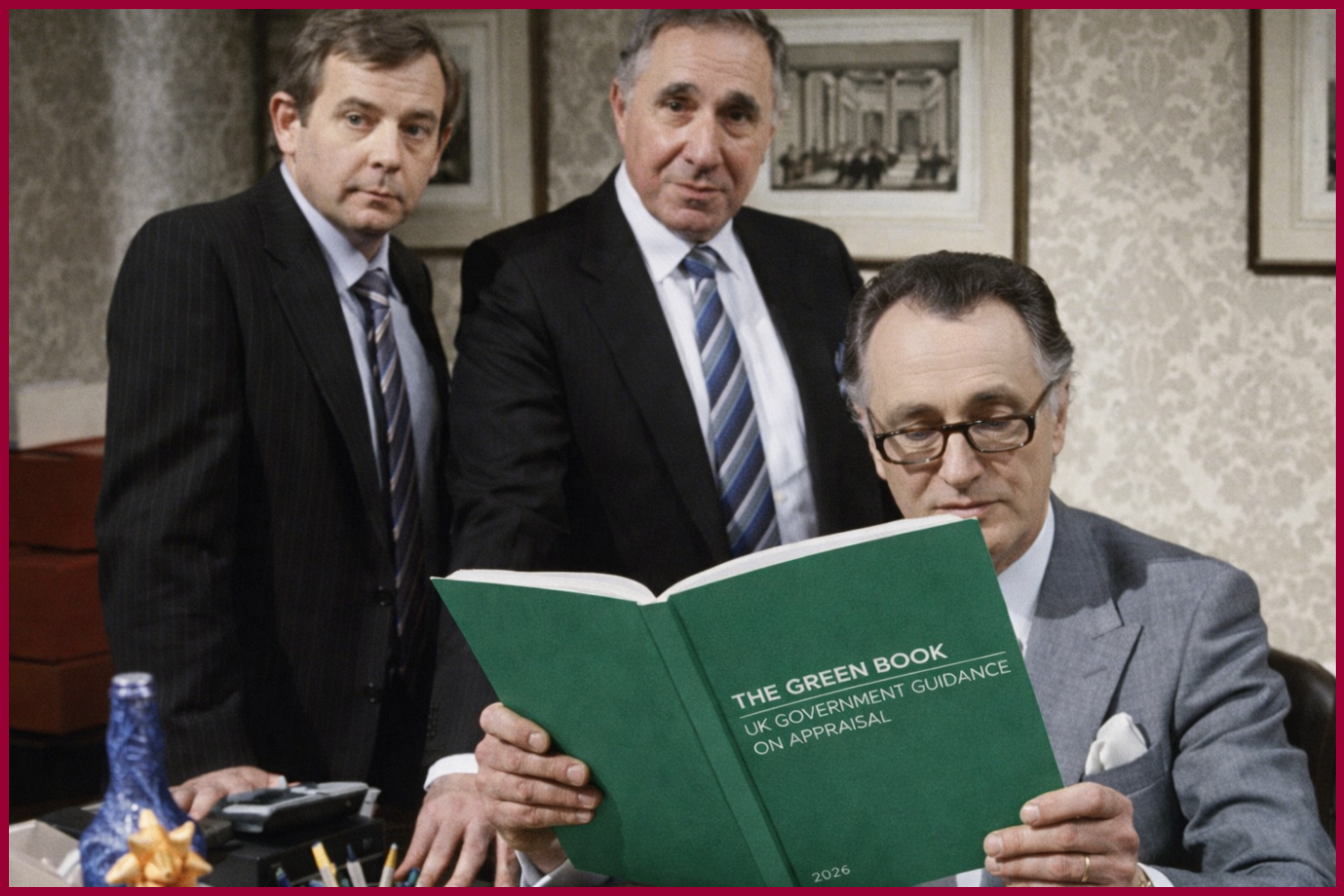
As a mandarin for many a year, and Green Book consultee, I can imagine the scene back in Whitehall. A minister bursts into the office, clutching the new Green Book, eyes shining.
“Sir Humphrey, this is marvellous. It’s completely new.”
Sir Humphrey adjusts his glasses, wryly smiles and replies “Indeed, Minister. Entirely new.”
Only last week, after much trailing, the latest iteration of the Green Book finally landed. On first inspection it does look different. It is certainly shorter and there is less emphasis on unnecessary technical complexity. All very welcome. But what has really changed?
The genius of His Majesty’s Treasury has never been brute force. It is process. Over decades, the Treasury has perfected the art of winning quietly, preferably while others believe they have secured a concession. The question, then, is whether the new Green Book is a masterclass in this venerable tradition?
Take land value uplift, my favourite dinner table topic. It’s still there, doing the heavy lifting. Will a housing scheme in Wigan now perform better, on paper, than one in Westminster? Answers on a postcard to SW1. However, encouragingly, there is greater emphasis on external impacts such as the place-making effects for areas in need of regeneration.
To misquote Morecambe & Wise, is it the same tune, played slightly faster, with a new arrangement? Ministers may believe they are backing regeneration and rebalancing. In practice are they still backing spreadsheets underpinned by high land values?
Then there is our old friend, the benefit cost ratio, or BCR. This remains the supreme arbiter, the constitutional monarch of appraisal. Everything bows to it eventually. Time savings become money. Wellbeing becomes money. Environmental impacts become money. Of course, the new Green Book nods earnestly towards distributional effects and place-based outcomes, and this is to be praised, and used appropriately can make a difference.
The Green Book remains the gold standard of appraisal guidance, respected across the globe. The real question is whether this new iteration changes outcomes. Will benefits be shared more fairly? Will environmental limits constrain economic arithmetic rather than being adjusted to fit it? To borrow Sir Humphrey’s phrasing again “That depends entirely on what you mean by change.”
Simon Dancer leads our Economics service